Wednesday, August 31, 2005
Blogging downside
It burns me to the core when I see blogs talking about themselves. However, much as I hate to admit it, the first Google search result for "patientetherised" is this website. I hate the fact that I'm saying it, or even that I noticed. It's like a circle jerk with only one participant. I'm so so sorry. Substantiative posting will resume... eventually. I'm doing something major and medical related on the 18th of September, so hopefully I will have a thought about that before it happens. If not... I would say I'm sorry, but S____y says we Americans apologize to much, so... deal.


Friday, August 26, 2005
My least favorite part
One of the basic organizing principles of medical school is that in the first year they explain how things work (physiology), and in the second year, they explain how things break (pathology). One downside to this is that pathology, and the ensuing treatments, are a lot more interesting than physiology, so as part of our first year, we get introduced to some basic ailments and their treatments, both to illustrate why things are important, and to keep us from getting bored.
From time to time, we look at various types of imaging studies, such as x-rays, CAT scans, MRI, and contrast studies like angiography or barium studies that look at the GI tract. Dr. X will often ask us, "What's wrong?" As in this example:
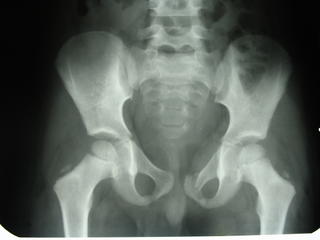
So, this is a plain film x-ray.* Bone and metal are white, soft tissue is gray, air is black. At first glimpse, there appear to be a lot of bone fragments, little white cirles that don't seem to go with anything. In fact, this is a child. Her bones have not yet finished ossifying, so in some parts they are composed of cartlidge, which doesn't block x-rays the way the calcium in real bone does. The big thick bone coming up form the bottom of the image is the femur (thigh bone) articulating with the three bones of the pelivs. The trick with looking at pediatric images for fractures is that you have to know where it's normal to have breaks in ossification, and where it's not. One easy way is to compare the left versus right sides. A simple analysis is below:

O.K., so the left pubic bone is fractured (x-rays are read as if the patient were facing you). The disrupted pubic symphysis and very slight dislocation of the left femur are results of this. Why is this my least favorite part? The answer is found in the answer to this question - what's the differential diagnosis for a pediatric fractured pubis? This is a complicated way of asking, "What could be the cause?" If you're lucky, thre's a car accident in the near past. If not, the most likely cause is child abuse.
*I don't know who this is, or the age. There are no identifying marks, therefore I consider this sanitized for the purpose of privacy. The image is a picture I took of a plain film, so it is not form any case online.
From time to time, we look at various types of imaging studies, such as x-rays, CAT scans, MRI, and contrast studies like angiography or barium studies that look at the GI tract. Dr. X will often ask us, "What's wrong?" As in this example:

So, this is a plain film x-ray.* Bone and metal are white, soft tissue is gray, air is black. At first glimpse, there appear to be a lot of bone fragments, little white cirles that don't seem to go with anything. In fact, this is a child. Her bones have not yet finished ossifying, so in some parts they are composed of cartlidge, which doesn't block x-rays the way the calcium in real bone does. The big thick bone coming up form the bottom of the image is the femur (thigh bone) articulating with the three bones of the pelivs. The trick with looking at pediatric images for fractures is that you have to know where it's normal to have breaks in ossification, and where it's not. One easy way is to compare the left versus right sides. A simple analysis is below:
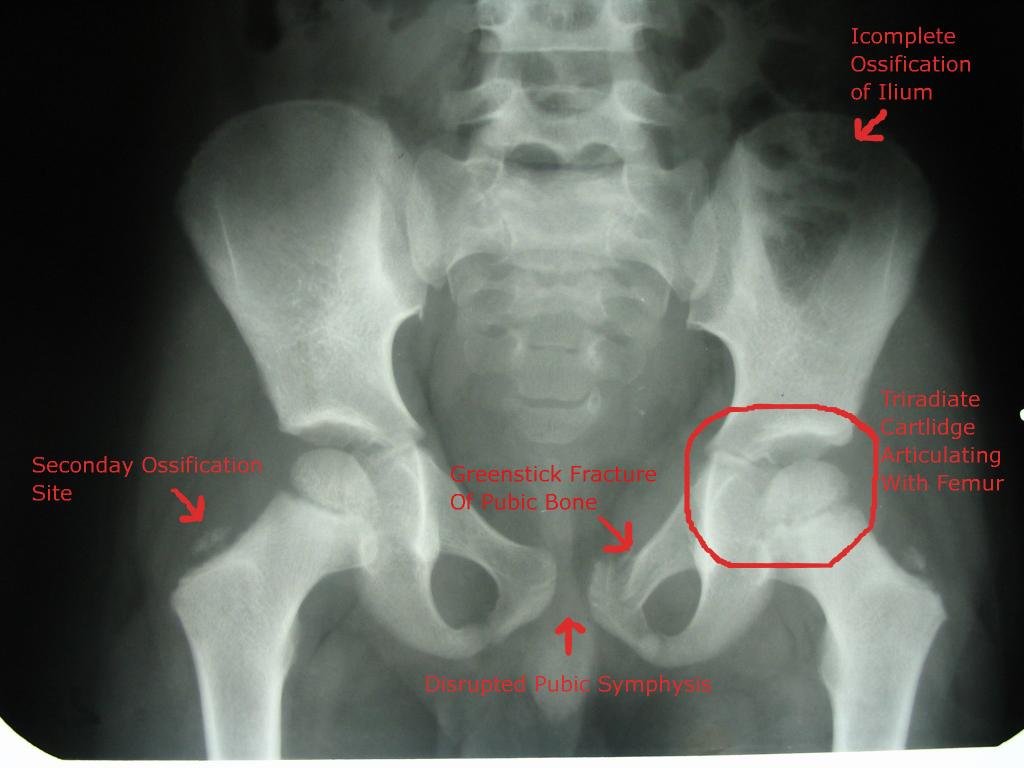
O.K., so the left pubic bone is fractured (x-rays are read as if the patient were facing you). The disrupted pubic symphysis and very slight dislocation of the left femur are results of this. Why is this my least favorite part? The answer is found in the answer to this question - what's the differential diagnosis for a pediatric fractured pubis? This is a complicated way of asking, "What could be the cause?" If you're lucky, thre's a car accident in the near past. If not, the most likely cause is child abuse.
*I don't know who this is, or the age. There are no identifying marks, therefore I consider this sanitized for the purpose of privacy. The image is a picture I took of a plain film, so it is not form any case online.
Tuesday, August 23, 2005
Survey Part II
The second survey I took recently (see below for Part I) was a course evaluation of the anatomy class whose final is this Friday. Three questions stand out to me:
Please indicate the degree to which you agree or disagree with the following statements from 1 (Strongly Disagree) to 5 (Strongly Agree).*
6. Encouraged critical, independent thinking.
7. Stimulated and facilitated questions and discussions.
8. Motivated independent study in the topic area.
When I got to this point, I said, "Wait, these are course objectives?" It's objectively true that the course didn't encourage these things. It's objectively true that when a controversy came up, our professor would say things like, "We can argue all day about this - Moore says 5 muscles, Clemente says 7, Grant has 4, Grey has 10, Hollinshead says something else entirely. Ultimately, when you think about abducting your arm, it's really only two muscles - supraspinatus and deltoid."** So thinking, discussing, and searching for alternate explanations were never on the plate.
Could this be some kind of crazy form borrowed from the English department because the School of Medicine didn't want to write their own evaluation form? Nope - the forms are different, and the school of medicine one even has our little crest in the corner.
So then, what's going on? I'm not sure, but my next question is - are these things actually course objectives, and should they be? Turning back to Volume I, Page 1 of the syllabus, the course objectives seem to be to:
1. Provide a course of study that will not only be inspiring but efficient and economical.
2. Integrate basic anatomical facts and concepts into a framework of clinical thinking.
3. Be a positive and defining experience - interesting, challenging, and enjoyable.*
No mention of discussion, critical thinking, or independant study. This exonerates the course from false advertising, but the inevitable followup is to wonder whether these course objectives (to the extent that they were fulfilled) form the basis of a viable course. My answer is yes. My impression in this course, as in many science courses, is that the principles of efficiency and economy require us to ignore many controversies, nits, and details, simply because they would distract us from our course of study. Given the choice between covering the material we have, and discussing what makes a "fact" a fact, a 'fact,' a "scientific fact," a 'scientific fact' or what have you, actually talking about something is far preferrable. I can quibble with the best of them, and I don't need more practice.
What about inspiration, acting as a defining experience? Surely I don't go for that crap? Actually, I do. The problem with this blog is that I'm normally only motivated to write when I'm pissed off and partisan, but you can see the chink in my thinking in Survey Part I where I said, "That's why I'm putting up with you people in the first place." There's a big distance between writing an essay about how I want to help people and actually doing it. Somewhere in there is the moment when I stop thinking "How cool is it to be here"" and start thinking "How can I use this to improve the world?" There is the moment when I decide that saving lives is more important than collecting data. There is the moment that I realize that someone's life will be in my hands, the moment it actually is, and moment what I let it slip. One of the outcomes of my interview odessy is that I realized medical training changes you, and I decided that this change is part of my mission in life.
So it's been amazing, nerve-wracking, boring, fascinating, long, grueling, vital, and unique. That's more than enough for any course. Best course I ever had? I'm not sure. Dog Lab was probably the most life changing, Molecular Bio and Physiology are also up there. Let's say Top 7 at least. And despite my last post, just because we don't haggle about the embryological origin of the Sinoatrial Node doesn't mean I'm a soulless technocrat, or that I've lost my ability to dissent. It means I've learned the ability to hold my fire.
* As always edited for brevity and clarity.
** Made up, but representative. The names are names of common anatomy texts. If you really really want to read them, go search for them on Amazon yourself.
P.S. What I can't figure out is why SOM has these objectives on the evaluation sheet if they're not actually objectives for the classes.
Please indicate the degree to which you agree or disagree with the following statements from 1 (Strongly Disagree) to 5 (Strongly Agree).*
6. Encouraged critical, independent thinking.
7. Stimulated and facilitated questions and discussions.
8. Motivated independent study in the topic area.
When I got to this point, I said, "Wait, these are course objectives?" It's objectively true that the course didn't encourage these things. It's objectively true that when a controversy came up, our professor would say things like, "We can argue all day about this - Moore says 5 muscles, Clemente says 7, Grant has 4, Grey has 10, Hollinshead says something else entirely. Ultimately, when you think about abducting your arm, it's really only two muscles - supraspinatus and deltoid."** So thinking, discussing, and searching for alternate explanations were never on the plate.
Could this be some kind of crazy form borrowed from the English department because the School of Medicine didn't want to write their own evaluation form? Nope - the forms are different, and the school of medicine one even has our little crest in the corner.
So then, what's going on? I'm not sure, but my next question is - are these things actually course objectives, and should they be? Turning back to Volume I, Page 1 of the syllabus, the course objectives seem to be to:
1. Provide a course of study that will not only be inspiring but efficient and economical.
2. Integrate basic anatomical facts and concepts into a framework of clinical thinking.
3. Be a positive and defining experience - interesting, challenging, and enjoyable.*
No mention of discussion, critical thinking, or independant study. This exonerates the course from false advertising, but the inevitable followup is to wonder whether these course objectives (to the extent that they were fulfilled) form the basis of a viable course. My answer is yes. My impression in this course, as in many science courses, is that the principles of efficiency and economy require us to ignore many controversies, nits, and details, simply because they would distract us from our course of study. Given the choice between covering the material we have, and discussing what makes a "fact" a fact, a 'fact,' a "scientific fact," a 'scientific fact' or what have you, actually talking about something is far preferrable. I can quibble with the best of them, and I don't need more practice.
What about inspiration, acting as a defining experience? Surely I don't go for that crap? Actually, I do. The problem with this blog is that I'm normally only motivated to write when I'm pissed off and partisan, but you can see the chink in my thinking in Survey Part I where I said, "That's why I'm putting up with you people in the first place." There's a big distance between writing an essay about how I want to help people and actually doing it. Somewhere in there is the moment when I stop thinking "How cool is it to be here"" and start thinking "How can I use this to improve the world?" There is the moment when I decide that saving lives is more important than collecting data. There is the moment that I realize that someone's life will be in my hands, the moment it actually is, and moment what I let it slip. One of the outcomes of my interview odessy is that I realized medical training changes you, and I decided that this change is part of my mission in life.
So it's been amazing, nerve-wracking, boring, fascinating, long, grueling, vital, and unique. That's more than enough for any course. Best course I ever had? I'm not sure. Dog Lab was probably the most life changing, Molecular Bio and Physiology are also up there. Let's say Top 7 at least. And despite my last post, just because we don't haggle about the embryological origin of the Sinoatrial Node doesn't mean I'm a soulless technocrat, or that I've lost my ability to dissent. It means I've learned the ability to hold my fire.
* As always edited for brevity and clarity.
** Made up, but representative. The names are names of common anatomy texts. If you really really want to read them, go search for them on Amazon yourself.
P.S. What I can't figure out is why SOM has these objectives on the evaluation sheet if they're not actually objectives for the classes.
Sunday, August 21, 2005
Nearing the end
I've finished the content part of anatomy. I've learned the name of most every part of the body, and what connects with what. I know the signs of certain textbook illnesses. I can make sense of studies made with various imaging Devices, such as plain-film x-ray, CT, magnetic resonance, and the images made using various contrast agents.* I have been indoctrinated in simple Procedures used to influence the Sphere of Life. My Genius has been praised. I have sat in on research Symposia, and been introduced to the modern medical Paradigm...
"A mage with this level of Conditioning has been Processed. Substitute a technological focus for each of his Spheres. He is now a Technocrat."**
*Actually, I seem to be surprisingly good radiology - things tend to make sense, and it's the one area where I'm definitely better than my peers (whereas in everything else I'm about average)
**Brucato P, Campbell B, Long S, deMayo T, Taylor S. Guide to the Technocracy. White Wolf, 1999. p90
What this means, to you non-Mage players is that I've been indoctrinated and inducted. I'm one of the brotherhood now, with a diminished tendency to question received wisdom, and the accompanying increase in my perception of self importance and authority.
"A mage with this level of Conditioning has been Processed. Substitute a technological focus for each of his Spheres. He is now a Technocrat."**
*Actually, I seem to be surprisingly good radiology - things tend to make sense, and it's the one area where I'm definitely better than my peers (whereas in everything else I'm about average)
**Brucato P, Campbell B, Long S, deMayo T, Taylor S. Guide to the Technocracy. White Wolf, 1999. p90
What this means, to you non-Mage players is that I've been indoctrinated and inducted. I'm one of the brotherhood now, with a diminished tendency to question received wisdom, and the accompanying increase in my perception of self importance and authority.
Saturday, August 20, 2005
The Spanish Brandy
I burst into my Program Director's office last week.
I: What does Dr. X drink?
PD: What?
I: Well, our anatomy prof? Dr. X? He's really good. We want to get him a nice bottle of alcohol, and I figured you knew him.* So, what would be an appropriate gift?
PD (Gets out from behind his desk, reaches into his office cupboard, takes out a bottle of Spanish brandy): Give him this.
I (surprised): Is it any good?
PD: Of course.
I (put the bottle in my bag): OK. ... Thanks!
PD: Just don't drink it, OK? And don't tell him I gave it to you.
*The prof in question got this stint by being competant, but also because he crossed paths with our PD, who offered him the job of teaching us.
I: What does Dr. X drink?
PD: What?
I: Well, our anatomy prof? Dr. X? He's really good. We want to get him a nice bottle of alcohol, and I figured you knew him.* So, what would be an appropriate gift?
PD (Gets out from behind his desk, reaches into his office cupboard, takes out a bottle of Spanish brandy): Give him this.
I (surprised): Is it any good?
PD: Of course.
I (put the bottle in my bag): OK. ... Thanks!
PD: Just don't drink it, OK? And don't tell him I gave it to you.
*The prof in question got this stint by being competant, but also because he crossed paths with our PD, who offered him the job of teaching us.
Friday, August 19, 2005
Surveys I
I took a pair of surveys today. One of them is the AAMC Matriculating student questionaire. Briefly, the American Association of Medical Colleges is the cabal of most every med school in the country (and some Canadians as well, perhaps). AAMC administers the test (MCAT) and the admissions system (AMCAS). They also keep track of what we, the students, think. I filled out a similar survey when I took the MCAT - this lets them compare matriculating students (those going to med school) vs the cohort that takes the test. It's confidential, thank God.
I had to enter my AMCAS ID#, which I probably typed several times a day every day for about six months, but has since completely fled my mind. I had hoped that I might stop being a number at some point...
1. When did you definitely decide that you wanted to study medicine?*
I remember this question from back in the day, because my answer "Dude, I haven't" wasn't one of the options. I guess now it would be "during senior year." Though, my decision of whether to actually practice is still up in the air. My desire to practice is kind of like Stockholm Syndrome. The more time I spend around physicians, the more I want to be one. Conversely, since I started thinking about graduate courses, my desire to practice is receeding.
6. Indicate how important the following factors were in your choice of medicine as a career goal by selecting one of the five options to the right of each factor: (Options are Not at all Important ... Very Important)
a. Profession provides opportunity for research
Very Important
b. Profession provides opportunity to develop expertise in a specialized area
What? I could develop expertise in the specialized area of guessing people's ZIP codes from their addresses... but why? Not at all Important
c. Profession provides opportunity to make a difference in people's lives
Where's the circle for: "That's why I'm putting up with you people in the first place" ?
d. Profession provides opportunity to use manual dexterity skills
I'll let this pass.
e. Physicians can have significant control of their work hours
I dunno AAMC, are you glad you stopped beating your wife?
f. Doctors can find practices that limit their amount of work stress
See e.
7. How important were the following individuals and experiences in your decision to study medicine?
g. Particular book, article, film, television program
No, as a matter of fact, I was not one of those geeks who ran home early from Dog Lab to watch ER.
8. How important were the following factors in your choice of this particular medical school?
a. General reputation of school
Yes, I was so excited Dupont was ranked #3 I set my house on fire.**
b. Amount of financial support offered
Very Important.
c. Nature of school's curriculum
As opposed to its demeanor? Not Important.
d. Ability of school to place students in particular residency programs
I didn't know I wanted to go to fancy-schmancy residency programs until I knew I could go to fancy-schmancy residency programs if I went to fancy-schmancy places. Of course, MD/PhD obviates the need for F/S med school, but still. Somewhat Important.
e. It was the only school to offer admission
But then again, it was the school I most wanted to go to. Very Important.
f. Friendliness of the administrator, faculty, and/or students
This is why.
32a. Regardless of your dependency status, please indicate your parents' combined gross income for last year (a rough estimate is sufficient).
Riiight. "$0"
35. How do you plan to finance your medical school education? Please enter a percentage for each applicable category to total 100%.
Now, is this "Work study" or "Award/Scholarship"? Some of my classmates list their occupation as 'indentured servant.' Split the difference.
I consent to have personally identifiable information released to my medical school. I understand that the medical school will not distribute this information to organizations or persons in any form that will permit personal identification of me.
You've got to be kidding me.
~~~~~
So, what does this survey mean? To me, it implies that medicine thinks rather positively of itself, and expects us to think positively of it as well. I left out some issue questions that ask about what we think about the future of medicine, but they struck me as grist for AAMC publications - "87% of incoming medical students think that physicians will be less well paid in the future - we must do something about it!"
It also tells me that the profession isn't ready for me, or that I'm not ready for the profession. Many of the questions asked about things that never even crossed my mind. I wonder what has changed since then. Have some of the questions become more relevant? Was the old survey sitting in my file, screaming, "ZSN has no business being in medicine"?
* Questions are edited for brevity, many are removed entirely.
** Dupont University, borrowed from Tom Wolfe, does not exist. I exist. Therefore, I do not attend Dupont Univeristy. Twit.
I had to enter my AMCAS ID#, which I probably typed several times a day every day for about six months, but has since completely fled my mind. I had hoped that I might stop being a number at some point...
1. When did you definitely decide that you wanted to study medicine?*
I remember this question from back in the day, because my answer "Dude, I haven't" wasn't one of the options. I guess now it would be "during senior year." Though, my decision of whether to actually practice is still up in the air. My desire to practice is kind of like Stockholm Syndrome. The more time I spend around physicians, the more I want to be one. Conversely, since I started thinking about graduate courses, my desire to practice is receeding.
6. Indicate how important the following factors were in your choice of medicine as a career goal by selecting one of the five options to the right of each factor: (Options are Not at all Important ... Very Important)
a. Profession provides opportunity for research
Very Important
b. Profession provides opportunity to develop expertise in a specialized area
What? I could develop expertise in the specialized area of guessing people's ZIP codes from their addresses... but why? Not at all Important
c. Profession provides opportunity to make a difference in people's lives
Where's the circle for: "That's why I'm putting up with you people in the first place" ?
d. Profession provides opportunity to use manual dexterity skills
I'll let this pass.
e. Physicians can have significant control of their work hours
I dunno AAMC, are you glad you stopped beating your wife?
f. Doctors can find practices that limit their amount of work stress
See e.
7. How important were the following individuals and experiences in your decision to study medicine?
g. Particular book, article, film, television program
No, as a matter of fact, I was not one of those geeks who ran home early from Dog Lab to watch ER.
8. How important were the following factors in your choice of this particular medical school?
a. General reputation of school
Yes, I was so excited Dupont was ranked #3 I set my house on fire.**
b. Amount of financial support offered
Very Important.
c. Nature of school's curriculum
As opposed to its demeanor? Not Important.
d. Ability of school to place students in particular residency programs
I didn't know I wanted to go to fancy-schmancy residency programs until I knew I could go to fancy-schmancy residency programs if I went to fancy-schmancy places. Of course, MD/PhD obviates the need for F/S med school, but still. Somewhat Important.
e. It was the only school to offer admission
But then again, it was the school I most wanted to go to. Very Important.
f. Friendliness of the administrator, faculty, and/or students
This is why.
32a. Regardless of your dependency status, please indicate your parents' combined gross income for last year (a rough estimate is sufficient).
Riiight. "$0"
35. How do you plan to finance your medical school education? Please enter a percentage for each applicable category to total 100%.
Now, is this "Work study" or "Award/Scholarship"? Some of my classmates list their occupation as 'indentured servant.' Split the difference.
I consent to have personally identifiable information released to my medical school. I understand that the medical school will not distribute this information to organizations or persons in any form that will permit personal identification of me.
You've got to be kidding me.
~~~~~
So, what does this survey mean? To me, it implies that medicine thinks rather positively of itself, and expects us to think positively of it as well. I left out some issue questions that ask about what we think about the future of medicine, but they struck me as grist for AAMC publications - "87% of incoming medical students think that physicians will be less well paid in the future - we must do something about it!"
It also tells me that the profession isn't ready for me, or that I'm not ready for the profession. Many of the questions asked about things that never even crossed my mind. I wonder what has changed since then. Have some of the questions become more relevant? Was the old survey sitting in my file, screaming, "ZSN has no business being in medicine"?
* Questions are edited for brevity, many are removed entirely.
** Dupont University, borrowed from Tom Wolfe, does not exist. I exist. Therefore, I do not attend Dupont Univeristy. Twit.
Tuesday, August 16, 2005
External genetalia - awesome
We're almost done, only the pelvis and perineum remain. In keeping with that theme, I give you the following image. This image is part of a series designed to contrast the simplicity (and overall awesomeness) of the cock and balls with the overwrought and complicated female reproductive tract. Unfortunately, the penis drawing (which consisted of a penis with many regions that were all labelled 'awesome') has been lost, only the vaginabeast remains:


Wednesday, August 10, 2005
Persistence
There is a quote in the anatomy lab:
Nothing in the world can take the place of persistence.
Talent will not; nothing is more common than unsuccessful men with talent.
Genius will not; unrewarded genius is almost a proverb.
Education will not; the world is full of educated derelicts.
Persistence and determination alone are omnipotent.
The implication is obvious - we need to work like crazy, or else we will fail, or at least fail to make our mark on the world. From here, my thoughts go in several directions. First, the whole quote, then a close reading of the quote as written (which is boring as hell), then how it relates to my thinking (also very boring).
Turns out, the remainder of the quote is, "The slogan 'Press On' has solved and always will solve the problems of the human race." This doesn't sound too bad, just a call to take control of your life. More significant (I think) are the speaker and the date, those being Calvin Coolidge and 1932.
Calvin Coolidge was president during the late 1920s. The stories of wealth , lack of foresight, and belief in unlimited prosperity from this period should have been ground into your mind in the 11th grade (as they were into mine). Reread Gatsby for a refresher. My PhD will not be in economics, but my understanding is that at least some of the causes of the greatness of the great depression were created or allowed to fester during Coolidge's administration. Wikipedia states, "Even in 1929, after nearly a decade of economic growth, more than half the families in America lived on the edge or below the subsistence level—too poor to share in the great consumer boom of the 1920s, too poor to buy the cars and houses and other goods the industrial economy was producing, too poor in many cases to buy even the adequate food and shelter for themselves." You may recall that the great depression began in Europe prior to it's American begining in October 1929. The European nations, understandably hard-up for cash asked Coolidge for relief and he replied, "They hired the money, didn't they?" You can see, he was not exactly a compassionate person. Telling somebody that was laid off because of a global depression and is incapable of feeding their family that they need to "Press on" is a kick in the teeth, plain and simple.
What does this actually say? I'm not talking AP English style close reading, I'm talking what's the meaning. The first sentence says that only persistence can be persistence. This in and of itself is meaningless. Nothing in the world can take the place of ice cream. Nothing in the world can take the place of road tar. Nothing in the world can take the place of some woman's dead husband on Law & Order. What is more common, unsuccessful men with talent, or bacteria in the colons of the unsuccesful men with talent? Perhaps we should read that as saying that the most common outcome for talented men is to be unsuccessful, in which case I would be better off sticking Crayons in my head Homer Simpson style than going to anatomy lab. I suppose I could always hope I'm one of the lucky ones (truly nothing in the world can take the place of luck), but unfortunately I'm pretty smart... It seems odd that an institution that exists to promote and sell (for an impressive price) education is claiming that the world is already stuffed with "educated derelicts." I'm reading the last line to say that the combination of persistence and determination combine to do... something. The concepts are omnipotent, but does that mean that potence is proportional to persistence x determination, or is it an all or nothing thing? What happens when two persistent people come into conflict?
Fortunately, this isn't a scientific pronouncement, so such close reading, while annoying, is not necessary.
This seems like a fairly benign, somehwat overwrought call to keep buggering on (or KBO as Churchill might say). It does make one want to reach for the Demotivators (this one and this one seem quite appropriate), but this in and of itself is more a reflection of my cynicism. I said before that this is "a call to take control of your life," but that's incorrect. The reason that I made that particular leap is that I conflated this recipe for success with my own. Mine is simply to internalize my locus of control. What does that mean? It means that I believe I am in control of my life. I realize that I can't control everything that happens, but I can control the probabilities that they will happen. I can't guarantee that I won't lose my keys (or cell phone, or mp3 player or any other small item), but I can do things that will greatly decrease the probability of that occuring, things like checking my pockets before I leave somewhere.
The same is true of grades. You can't control what will be on the test, but you have a pretty good idea what the questions will be, and you know how to study for them. A lot of work is required, yes, but also talent, genius, previous education, and a host of other traits - the wisdom to know when to ask for help, and the humility to actually make the request, for instance.
So what bothers me most about this statement is the idea that I am not in control off my success, and that the only way to attain success or power is to submit to a regime of persistence. As WSC might say, "Never give in--never, never, never, never, in nothing great or small, large or petty, never give in except to convictions of honour and good sense. Never yield to force; never yield to the apparently overwhelming might of the enemy." That is, know when to stop beating your head against the wall.
Nothing in the world can take the place of persistence.
Talent will not; nothing is more common than unsuccessful men with talent.
Genius will not; unrewarded genius is almost a proverb.
Education will not; the world is full of educated derelicts.
Persistence and determination alone are omnipotent.
The implication is obvious - we need to work like crazy, or else we will fail, or at least fail to make our mark on the world. From here, my thoughts go in several directions. First, the whole quote, then a close reading of the quote as written (which is boring as hell), then how it relates to my thinking (also very boring).
Turns out, the remainder of the quote is, "The slogan 'Press On' has solved and always will solve the problems of the human race." This doesn't sound too bad, just a call to take control of your life. More significant (I think) are the speaker and the date, those being Calvin Coolidge and 1932.
Calvin Coolidge was president during the late 1920s. The stories of wealth , lack of foresight, and belief in unlimited prosperity from this period should have been ground into your mind in the 11th grade (as they were into mine). Reread Gatsby for a refresher. My PhD will not be in economics, but my understanding is that at least some of the causes of the greatness of the great depression were created or allowed to fester during Coolidge's administration. Wikipedia states, "Even in 1929, after nearly a decade of economic growth, more than half the families in America lived on the edge or below the subsistence level—too poor to share in the great consumer boom of the 1920s, too poor to buy the cars and houses and other goods the industrial economy was producing, too poor in many cases to buy even the adequate food and shelter for themselves." You may recall that the great depression began in Europe prior to it's American begining in October 1929. The European nations, understandably hard-up for cash asked Coolidge for relief and he replied, "They hired the money, didn't they?" You can see, he was not exactly a compassionate person. Telling somebody that was laid off because of a global depression and is incapable of feeding their family that they need to "Press on" is a kick in the teeth, plain and simple.
What does this actually say? I'm not talking AP English style close reading, I'm talking what's the meaning. The first sentence says that only persistence can be persistence. This in and of itself is meaningless. Nothing in the world can take the place of ice cream. Nothing in the world can take the place of road tar. Nothing in the world can take the place of some woman's dead husband on Law & Order. What is more common, unsuccessful men with talent, or bacteria in the colons of the unsuccesful men with talent? Perhaps we should read that as saying that the most common outcome for talented men is to be unsuccessful, in which case I would be better off sticking Crayons in my head Homer Simpson style than going to anatomy lab. I suppose I could always hope I'm one of the lucky ones (truly nothing in the world can take the place of luck), but unfortunately I'm pretty smart... It seems odd that an institution that exists to promote and sell (for an impressive price) education is claiming that the world is already stuffed with "educated derelicts." I'm reading the last line to say that the combination of persistence and determination combine to do... something. The concepts are omnipotent, but does that mean that potence is proportional to persistence x determination, or is it an all or nothing thing? What happens when two persistent people come into conflict?
Fortunately, this isn't a scientific pronouncement, so such close reading, while annoying, is not necessary.
This seems like a fairly benign, somehwat overwrought call to keep buggering on (or KBO as Churchill might say). It does make one want to reach for the Demotivators (this one and this one seem quite appropriate), but this in and of itself is more a reflection of my cynicism. I said before that this is "a call to take control of your life," but that's incorrect. The reason that I made that particular leap is that I conflated this recipe for success with my own. Mine is simply to internalize my locus of control. What does that mean? It means that I believe I am in control of my life. I realize that I can't control everything that happens, but I can control the probabilities that they will happen. I can't guarantee that I won't lose my keys (or cell phone, or mp3 player or any other small item), but I can do things that will greatly decrease the probability of that occuring, things like checking my pockets before I leave somewhere.
The same is true of grades. You can't control what will be on the test, but you have a pretty good idea what the questions will be, and you know how to study for them. A lot of work is required, yes, but also talent, genius, previous education, and a host of other traits - the wisdom to know when to ask for help, and the humility to actually make the request, for instance.
So what bothers me most about this statement is the idea that I am not in control off my success, and that the only way to attain success or power is to submit to a regime of persistence. As WSC might say, "Never give in--never, never, never, never, in nothing great or small, large or petty, never give in except to convictions of honour and good sense. Never yield to force; never yield to the apparently overwhelming might of the enemy." That is, know when to stop beating your head against the wall.
Tuesday, August 02, 2005
Head and neck anatomy joke
After finishing the practical exam.
I: Do you know why God gave us V1?
TA: Umm... why?
I: So you can tell when you're banging you head on the wall.
This won't make it funny, but the explanation for this joke is that sensation to your forehead is provided by the 1st division (1) of the fifth cranial nerve (V), thus V1. Yeah...
I: Do you know why God gave us V1?
TA: Umm... why?
I: So you can tell when you're banging you head on the wall.
This won't make it funny, but the explanation for this joke is that sensation to your forehead is provided by the 1st division (1) of the fifth cranial nerve (V), thus V1. Yeah...
Sideline into the real world
According to Frank Foer of The New Republic, there is a broad international consensus that it will take Iran about 5 years to complete a nuclear weapon. Then he reports that the CIA says it will take Iran a decade.
Funny thing - the Jerusalem Post reports that the Israeli army (IDF) estimates that Iran will have nuclear weapons in 2008, that is 3 years. Consider the CIAs failure to predict the first atomic tests run by India and Pakistan. Consider their estimates, all their estimates, about Iraq. Recall who bombed the Osirak complex in 1981. Now, who are you gonna trust?
If I wasn't freaking out about anatomy, I'd be freaking out about this.
Funny thing - the Jerusalem Post reports that the Israeli army (IDF) estimates that Iran will have nuclear weapons in 2008, that is 3 years. Consider the CIAs failure to predict the first atomic tests run by India and Pakistan. Consider their estimates, all their estimates, about Iraq. Recall who bombed the Osirak complex in 1981. Now, who are you gonna trust?
If I wasn't freaking out about anatomy, I'd be freaking out about this.
Wednesday, July 27, 2005
What residency are you thinking of going into?
The funny thing about studying medicine all day is that it forces me to think in such a way that I assume I will become a practicing physician. Getting my medical liscence for fun seems less and less likely, doing strictly clinical research seems more and more likely. This is partially Dr. Amy's fault, partially Piper's fault, and partially the fact that medicine is so damned seductive.
"Come... zsn... don't you want... to save a life?"
"Come... zsn... don't you want... to save a life?"
Fitting in
It's been an incredibly busy last week. We had the histology midterm today, and are currently deep into Head and Neck, with the exam on next Tuesday. Rather stressful. Still, we had a chance to go out for one of my classmate's birthdays.
To clarify things, my classmates and I actually get along pretanaturally well. for instance, this was the third time we've gone out to eat and had to split the bill by everyone paying cash. Normally this turns into a debacle as no-one has money and the person that ends up paying gets stuck paying way too much, but with this group, it was smooth as silk.
We were joined by three second years. Two of them are the TAs, who have calmed down considerably since the begining of head and neck. It's now much clearer that their threats are in jest, and they really do wish us well. The third second year flunked anatomy, and so she is retaking with us. It's so incredibly helpful to have someone like that around since she knows the ropes, is one of those people who knows everyone,* and is quite sympathetic to us because we are in the same boat. She's obsessed with setting my overwhelmingly male class up with the incoming first years and her class of second years. I think it's rather cute, but appreciate that getting set up with people will also mean that I get to meet people.
Whenever we eat, MSTP with MD (or perhaps messed-up with normies), the rivalry always comes up. The problem is that people with very different career plans are in the same classes together so there will always be some cross talk, but understanding that doesn't make it any less likely to occur. One of the reasons I chose to come here is that the MD/PhD program here comprises a REAL MD and a REAL PhD - that is, full degrees, with nothing cut out, and very few relaxed requirements. In one of my first posts, I mentioned seing a group of MSTPs in a second year medical class describing their patients, and noted that the preceptor didn't realize they were MSTP until they told him they were going into the PhDs rather than into the clinical years of training (3rd and 4th years of med school). I therefore take it as a priority to fit in with the medical school class.
Thus, it bothers me that the TAs talk about playing 'spot the MSTP.' I suppose the year ahead of us was incredibly cliqeish in class the first year, and may have been haughty, but the thing is that we too will stick out. Having taken anatomy and histology, we won't be taking those classes with our MD counterparts. Physiology and Touchy-Feely I may help make up for it, but if we're not in there bitching about our anatomy readings, it could be difficult to connect. Ultimately, I think I care more about getting some friends here than having my administrative quirks remain unknown.
* Part of the reason that she knows everyone (other than the fact that she is rather outgoing) is that she failed anatomy. Everyone knows that she failed anatomy, therefore she knows everyone, and seems to enjoy her noteriety. She described me as the 'most sarcastic member of the class' a high honor, seeing as how we seem to have been admitted on the basis of most sardonic wit.
To clarify things, my classmates and I actually get along pretanaturally well. for instance, this was the third time we've gone out to eat and had to split the bill by everyone paying cash. Normally this turns into a debacle as no-one has money and the person that ends up paying gets stuck paying way too much, but with this group, it was smooth as silk.
We were joined by three second years. Two of them are the TAs, who have calmed down considerably since the begining of head and neck. It's now much clearer that their threats are in jest, and they really do wish us well. The third second year flunked anatomy, and so she is retaking with us. It's so incredibly helpful to have someone like that around since she knows the ropes, is one of those people who knows everyone,* and is quite sympathetic to us because we are in the same boat. She's obsessed with setting my overwhelmingly male class up with the incoming first years and her class of second years. I think it's rather cute, but appreciate that getting set up with people will also mean that I get to meet people.
Whenever we eat, MSTP with MD (or perhaps messed-up with normies), the rivalry always comes up. The problem is that people with very different career plans are in the same classes together so there will always be some cross talk, but understanding that doesn't make it any less likely to occur. One of the reasons I chose to come here is that the MD/PhD program here comprises a REAL MD and a REAL PhD - that is, full degrees, with nothing cut out, and very few relaxed requirements. In one of my first posts, I mentioned seing a group of MSTPs in a second year medical class describing their patients, and noted that the preceptor didn't realize they were MSTP until they told him they were going into the PhDs rather than into the clinical years of training (3rd and 4th years of med school). I therefore take it as a priority to fit in with the medical school class.
Thus, it bothers me that the TAs talk about playing 'spot the MSTP.' I suppose the year ahead of us was incredibly cliqeish in class the first year, and may have been haughty, but the thing is that we too will stick out. Having taken anatomy and histology, we won't be taking those classes with our MD counterparts. Physiology and Touchy-Feely I may help make up for it, but if we're not in there bitching about our anatomy readings, it could be difficult to connect. Ultimately, I think I care more about getting some friends here than having my administrative quirks remain unknown.
* Part of the reason that she knows everyone (other than the fact that she is rather outgoing) is that she failed anatomy. Everyone knows that she failed anatomy, therefore she knows everyone, and seems to enjoy her noteriety. She described me as the 'most sarcastic member of the class' a high honor, seeing as how we seem to have been admitted on the basis of most sardonic wit.
Wednesday, July 20, 2005
Head and Neck I
This unit start was particularly tough. Partially it might be that head and neck are an extremely complex region, but more importantly, the proff and the TAs seemed upset for some reason.
I think my attitude about the last test, and that of my classmates ticked off the TAs. We dismiss the difficulty of the class they're took, even though theirs was more in-depth. They go out of their way to make things easy for us, and our ingratitude and whining won't and shouldn't earn us any points. I need to do something about this.
The problem is that the amount of material seems overwhelming, and if you add in a hostile learning environment, I might as well start packing now, as I (half-jokingly) threatened to do before lab today. However, lab seemed to go much better, everyone was calmed down, smiling and laughing again and proud of our ability to pick things up.
Even I'm amazed. Eight hours ago, I knew nothing about the cranial nerves. Now, I know their names, numbers, foramena, and something of their innervation. Cold.
I think my attitude about the last test, and that of my classmates ticked off the TAs. We dismiss the difficulty of the class they're took, even though theirs was more in-depth. They go out of their way to make things easy for us, and our ingratitude and whining won't and shouldn't earn us any points. I need to do something about this.
The problem is that the amount of material seems overwhelming, and if you add in a hostile learning environment, I might as well start packing now, as I (half-jokingly) threatened to do before lab today. However, lab seemed to go much better, everyone was calmed down, smiling and laughing again and proud of our ability to pick things up.
Even I'm amazed. Eight hours ago, I knew nothing about the cranial nerves. Now, I know their names, numbers, foramena, and something of their innervation. Cold.
Anatomy update
Just finished the lower extremity (thigh, leg, foot, bits of hip that have to do with moving same). Test was on Monday. Got an 86% overall*, which I was kind of disappointed with compated to my 93% on the first exam, but the TAs pointed out that this exam was purposefully made more difficult, and it's a pass/fail class with a 75% threshold, and most people would kill to get our grade distribution. According to them, the test was about relationships and anatomical reasoning, which is basically prequisited on us having the anatomy cold - to have done as well as we did indicates that this was the case.
Now on the head and neck. We're getting a compressed version over the next week and a half (test on the 2nd). So, rather than posting, I ought to be reading my anatomy book and browsing my Netter's. Best of luck, all.
*81% on the written, 100% of slide id, and 89% on the lab practical. The slide id and practical are more identification oriented, thus justifying my reasoning.
Now on the head and neck. We're getting a compressed version over the next week and a half (test on the 2nd). So, rather than posting, I ought to be reading my anatomy book and browsing my Netter's. Best of luck, all.
*81% on the written, 100% of slide id, and 89% on the lab practical. The slide id and practical are more identification oriented, thus justifying my reasoning.
Tuesday, July 19, 2005
Abortion
Like Bill Clinton, I believe abortion should be safe, legal, and rare. Putting aside how many that should be, if you had asked me to guess this morning, I would have said that there are about 100,000 per year. I was off by a factor of ten.
Turns out there were about 1,293,000 in 2002 (via AS).
This turns into an incidence of 20.9 abortions per 1000 women aged 15-44 per year. I have no idea why the statistics are presented in this fashion. It would be more accessible to present them as 2.1% per year, which translates to a 50% reproductive lifetime risk of having an abortion.^1 Compare that to the 13% total rifetime risk of developing breast cancer (NCI).
We watched a video in class today^2 that compared embryonic development of different vertebrates, showing how wildly different structures have a common origin. It struck me that all the embryos that were presented in this rather upbeat, positive video were, in fact, dead and never going to complete the developmental journey that they were being used to celebrate. I'm grateful to the embryos and their families for giving me the opportunity to see this, and I thought the video was outstanding overall, but that twinge of sadness...
^1 You wanna quibble over statistics? Ok. Not likely to be productive, but...
Quibble 1: Spock suspects that the eggs are more in one basket, i.e. the same women keep having abortions. This seems to be the case in New York City, but overall it looks like most women are first timers.
Quibble 2: Harpo asserts that relatively few abortions are done on upper/middle class white women. Clearly, gender is a key factor in who gets abortions. Minorities are over-represented. Those who are in poverty or near poverty receive about 60% of abortions.
Clearly, there are more abortion statistics that I can keep track of, but even if 'only' 1 in 3 women will have an abortion, that's still a ton of people.
^2 I believe the video was "Oddesy of Life" from NOVA
Turns out there were about 1,293,000 in 2002 (via AS).
This turns into an incidence of 20.9 abortions per 1000 women aged 15-44 per year. I have no idea why the statistics are presented in this fashion. It would be more accessible to present them as 2.1% per year, which translates to a 50% reproductive lifetime risk of having an abortion.^1 Compare that to the 13% total rifetime risk of developing breast cancer (NCI).
We watched a video in class today^2 that compared embryonic development of different vertebrates, showing how wildly different structures have a common origin. It struck me that all the embryos that were presented in this rather upbeat, positive video were, in fact, dead and never going to complete the developmental journey that they were being used to celebrate. I'm grateful to the embryos and their families for giving me the opportunity to see this, and I thought the video was outstanding overall, but that twinge of sadness...
^1 You wanna quibble over statistics? Ok. Not likely to be productive, but...
Quibble 1: Spock suspects that the eggs are more in one basket, i.e. the same women keep having abortions. This seems to be the case in New York City, but overall it looks like most women are first timers.
Quibble 2: Harpo asserts that relatively few abortions are done on upper/middle class white women. Clearly, gender is a key factor in who gets abortions. Minorities are over-represented. Those who are in poverty or near poverty receive about 60% of abortions.
Clearly, there are more abortion statistics that I can keep track of, but even if 'only' 1 in 3 women will have an abortion, that's still a ton of people.
^2 I believe the video was "Oddesy of Life" from NOVA
Saturday, July 16, 2005
Sigh
This blog is intended to be half personal, half professional - that is, my reflections on my day to day professional student life should be the majority of the discussion. Here's something more personal - my personal pictures, on flickr, just to give you some visuals.
http://www.flickr.com/photos/patientetherised/
http://www.flickr.com/photos/patientetherised/
Thursday, July 14, 2005
By the way...
You may find yourself asking, "What's a medical student doing drooling over basic molecular biology papers."
Well, I'm a little MeST uP. (Pronounced "messed up").
You may find yourself asking, "What does that mean?" This is the short of it - an MD takes 4 years. A PhD in biology should, according to NIH, take 4 years. An MD/PhD takes (about) 8 years. At the end of this time you walk out with two doctorates.*
You may find yourself asking, "What can one do with an MD and a PhD?" The answer is this: Anything you fricking want. Seriously - you want to practice, go practice. You want to teach, go teach. You want to do research, of any kind, do so. You want to do some kind of bizarre hybrid in an effort to make all the years sunk into your degrees pay off? Go for it (It's difficult to do this well, but not unheard of).
*They take this very seriously at my institution. When you defend your PhD thesis, you do a hooding ceremony, graduation, parents come out, blah blah blah. When you graduate from Med school, you do a hooding ceremony, graduation, parents come out, blah blah blah. No requirements for either degree are waved. The idea is that we actually are earning two degrees, not two chunks of degree.
Well, I'm a little MeST uP. (Pronounced "messed up").
You may find yourself asking, "What does that mean?" This is the short of it - an MD takes 4 years. A PhD in biology should, according to NIH, take 4 years. An MD/PhD takes (about) 8 years. At the end of this time you walk out with two doctorates.*
You may find yourself asking, "What can one do with an MD and a PhD?" The answer is this: Anything you fricking want. Seriously - you want to practice, go practice. You want to teach, go teach. You want to do research, of any kind, do so. You want to do some kind of bizarre hybrid in an effort to make all the years sunk into your degrees pay off? Go for it (It's difficult to do this well, but not unheard of).
*They take this very seriously at my institution. When you defend your PhD thesis, you do a hooding ceremony, graduation, parents come out, blah blah blah. When you graduate from Med school, you do a hooding ceremony, graduation, parents come out, blah blah blah. No requirements for either degree are waved. The idea is that we actually are earning two degrees, not two chunks of degree.
RNA pathology, dangit
One area of research that I've thought about getting into is non-canonical RNA, that is, RNA which is not tRNA, nor rRNA, nor mRNA. Recently, we've seen big developments in RNA interference (RNAi) where you add RNA to a cell to get it to shut down production of the complimentary gene (Footnote 1). That was fairly interesting, then I stumbled onto microRNA (or miRNA), which are small RNA produced naturally by cells which fulfill various tasks. Most of them are unknown, but one is known to be involved in fly eye development. On my interviews here, I talked to someone working on long non-translated RNA, and also varients to the old standbys. For instance, there are multiple different versions of each of the tRNAs in humans -> what do they do, why do they exist?
Anyway, I had an interest in RNA pathology, that is, finding RNAs that cause or are involved in disease. People laughed. They said RNA was either too fundamental (tRNA, rRNA) or too low copy (miRNA, other non-mRNAs) to have enough effect to be seen on a human scale. Well. Check this out. In summary, there is a cluster of microRNAs (mir 17-92)that, in combination with other oncogenes (namely c-myc) cause tumours to grow faster (Footnote 2). Very exciting. However, it doesn't seem that they know how this newly relevant miRNA oncogene does its thing. Maybe someone (hint-hint) should investigate.
Footnote 1: A short explanation of RNAi with most of the detail stripped out. DNA exists in a double stranded, antiparallel condition, like so:
W: Start->AGTCGTACC->End
C: End<-TCAGCATGG<-Start
We arbitrarily label the strands W and C so that we can keep them straight. Say that W codes for a complete gene, the sequence of which is: AGTCGTAC. When the gene is activated, an enzyme comes along and transcribes the gene, producing a transcript. The transcript is made out of RNA, which uses "U" instead of "T," so it would be:
Start->AGUCGUACC->End
This piece of RNA is called messenger RNA or mRNA, it completes its function by meeting up with the ribosome, which translates the RNA into protein, according to the genetic code. This particular gene would produce a protein whose sequence is Serine-Alanine-Threonine. This has all been known since the mid sixties, major snooze factor.
Here's RNAi -> is you introduce RNA that is complimentary to the mRNA, the gene is shut down. What does this mean?
The mRNA is: Start->AGUCGUACC->End
The complimentary RNA would be: Start->GGUACGACU->End
Wait, that doesn't pair at all! Except that, it does because the pairing is anti-parallel, like so:
The mRNA is: Start->AGUCGUACC->End
The complimentary RNA would be: End<-UCAGCAUGG<-Start
Note that the complimentary RNA bears an eerie similarity to the C strand of the gene, such that if you expressed the C strand, you would produce that complimentary RNA.
So, you have the mRNA, and complimentary RNA. What happens next? They base pair, of course. The product is double stranded RNA (dsRNA). dsRNA is never encountered in multicellular organisms, except for in viruses. Therefore, whenever your cells see dsRNA in them, they interpret it as viral RNA. They then produce enzymes that destroy the mRNA of the gene, and may completely shut it down gene. This is called interference (hence RNAi). In plants, once a gene is shut down, it never comes back. In humans, the gene is only shut down as long as you keep adding the complementary RNA to the cell, and the amount of interference is proportional to the amount of complementary RNA you add. This is great for experimenters, in that you can see what happens if you have a range of expression of a gene, as opposed to the simple on/off allowed by genetic engineering. It is somewhat bad for patients, because if you are shutting down a harmful gene by giving the patient complementary RNA, the effect wears off quickly, and you have to give them a lot of RNA to see an effect (people are trying this as we speak, btw).
Footnote 2: He L, Thomson JM, Hemann MT, Hernando-Monge E, Mu D, Goodson S, Powers S, Cordon-Cardo C, Lowe SW, Hannon GJ, Hammond SM. A microRNA polycistron as a potential human oncogene. Nature. 2005 Jun 9;435(7043):828-33.
PMID = 15944707
I applied to CSHL for grad school, didn't even get called for an interview. I know who Hammond and Hannon, and I wanted to work for them, and if I were... sigh.
Update:
I read the paper. Not bad. I mean, there are holes you could drive a truck through, but I'm still hugely excited. They want to rename their gene oncomiR-1 - that's oncogenic micro RNA 1. Woo. It's like Ras in 1982.
Anyway, I had an interest in RNA pathology, that is, finding RNAs that cause or are involved in disease. People laughed. They said RNA was either too fundamental (tRNA, rRNA) or too low copy (miRNA, other non-mRNAs) to have enough effect to be seen on a human scale. Well. Check this out. In summary, there is a cluster of microRNAs (mir 17-92)that, in combination with other oncogenes (namely c-myc) cause tumours to grow faster (Footnote 2). Very exciting. However, it doesn't seem that they know how this newly relevant miRNA oncogene does its thing. Maybe someone (hint-hint) should investigate.
Footnote 1: A short explanation of RNAi with most of the detail stripped out. DNA exists in a double stranded, antiparallel condition, like so:
W: Start->AGTCGTACC->End
C: End<-TCAGCATGG<-Start
We arbitrarily label the strands W and C so that we can keep them straight. Say that W codes for a complete gene, the sequence of which is: AGTCGTAC. When the gene is activated, an enzyme comes along and transcribes the gene, producing a transcript. The transcript is made out of RNA, which uses "U" instead of "T," so it would be:
Start->AGUCGUACC->End
This piece of RNA is called messenger RNA or mRNA, it completes its function by meeting up with the ribosome, which translates the RNA into protein, according to the genetic code. This particular gene would produce a protein whose sequence is Serine-Alanine-Threonine. This has all been known since the mid sixties, major snooze factor.
Here's RNAi -> is you introduce RNA that is complimentary to the mRNA, the gene is shut down. What does this mean?
The mRNA is: Start->AGUCGUACC->End
The complimentary RNA would be: Start->GGUACGACU->End
Wait, that doesn't pair at all! Except that, it does because the pairing is anti-parallel, like so:
The mRNA is: Start->AGUCGUACC->End
The complimentary RNA would be: End<-UCAGCAUGG<-Start
Note that the complimentary RNA bears an eerie similarity to the C strand of the gene, such that if you expressed the C strand, you would produce that complimentary RNA.
So, you have the mRNA, and complimentary RNA. What happens next? They base pair, of course. The product is double stranded RNA (dsRNA). dsRNA is never encountered in multicellular organisms, except for in viruses. Therefore, whenever your cells see dsRNA in them, they interpret it as viral RNA. They then produce enzymes that destroy the mRNA of the gene, and may completely shut it down gene. This is called interference (hence RNAi). In plants, once a gene is shut down, it never comes back. In humans, the gene is only shut down as long as you keep adding the complementary RNA to the cell, and the amount of interference is proportional to the amount of complementary RNA you add. This is great for experimenters, in that you can see what happens if you have a range of expression of a gene, as opposed to the simple on/off allowed by genetic engineering. It is somewhat bad for patients, because if you are shutting down a harmful gene by giving the patient complementary RNA, the effect wears off quickly, and you have to give them a lot of RNA to see an effect (people are trying this as we speak, btw).
Footnote 2: He L, Thomson JM, Hemann MT, Hernando-Monge E, Mu D, Goodson S, Powers S, Cordon-Cardo C, Lowe SW, Hannon GJ, Hammond SM. A microRNA polycistron as a potential human oncogene. Nature. 2005 Jun 9;435(7043):828-33.
PMID = 15944707
I applied to CSHL for grad school, didn't even get called for an interview. I know who Hammond and Hannon, and I wanted to work for them, and if I were... sigh.
Update:
I read the paper. Not bad. I mean, there are holes you could drive a truck through, but I'm still hugely excited. They want to rename their gene oncomiR-1 - that's oncogenic micro RNA 1. Woo. It's like Ras in 1982.
Sunday, July 10, 2005

...not evil
Classmate 1: I need to relax this weekend
Classmate 2: Need a drink
C1: Smoke some weed
C3: Need something stronger. Get some heroin.
I: Sure, find the saphenous vein. Median malleoulus, 2 fingers up, 2 over, put in a line. You can run 500ml of heroin a minute.
C3: That's just twised.
I: Well, we haven't yet sworn to use our powers for good.
Classmate 2: Need a drink
C1: Smoke some weed
C3: Need something stronger. Get some heroin.
I: Sure, find the saphenous vein. Median malleoulus, 2 fingers up, 2 over, put in a line. You can run 500ml of heroin a minute.
C3: That's just twised.
I: Well, we haven't yet sworn to use our powers for good.
Subscribe to:
Posts (Atom)